
Custom Polyhedral Dice and Board Game Components: The Ultimate B2B Sourcing Guide
Sourcing custom tabletop game dice in bulk requires prioritizing material precision (such as acrylic, zinc alloy, and resin), strict balance testing, and reliable safety performance for international markets. For board game publishers and wholesale buyers, partnering directly with an experienced OEM/ODM manufacturer ensures customized tooling, scalable minimum order quantities (MOQ), and seamless global shipping tailored for crowdfunding and retail distribution.
Table of Contents
02 | Why Custom Dice and Components Matter in 2026?
03 | How Custom Dice Manufacturing Works
04 | B2B Sourcing Best Practices: Tabletop Accessories
05 | Custom Polyhedral Dice in Action
06 | Frequently Asked Questions (FAQs)
07 | Key Takeaways
01 | What is Custom Dice Manufacturing in B2B?
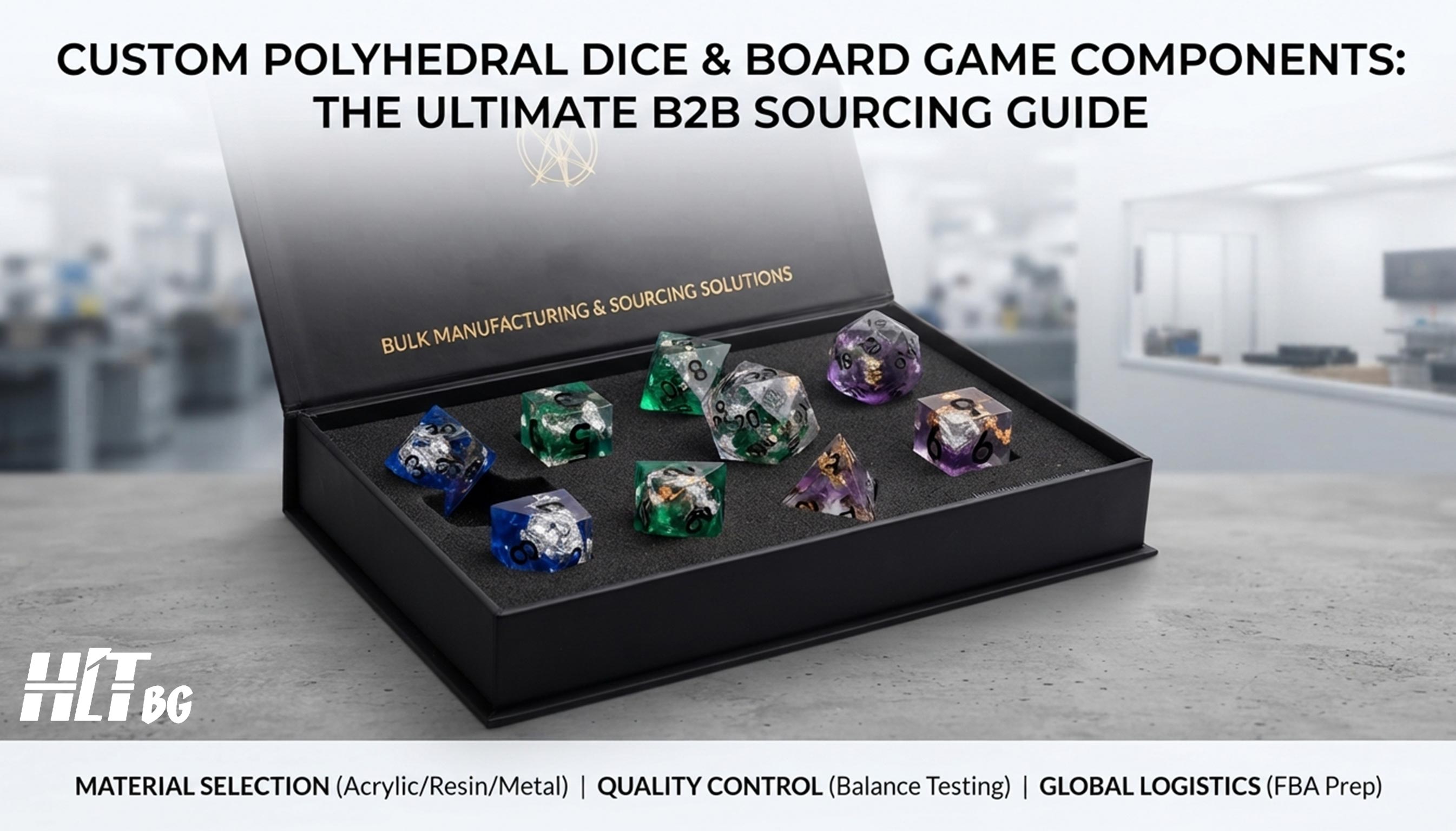
Custom dice manufacturing involves the bulk production of bespoke polyhedral sets (D4, D6, D8, D10, D12, D20, D100) and specialized game components tailored for tabletop publishers, game designers, and promotional merchandise brands. Unlike standard retail dice, B2B custom manufacturing allows complete control over dimensions, custom logos, font styles, custom resin inclusions, and electroplated metal finishes.
"In today's competitive tabletop market, bespoke components are no longer an afterthought-they are the primary physical anchor of brand identity and player immersion."
02 | Why Custom Dice and Components Matter in 2026?
The global tabletop games market continues to expand rapidly, driven by community-backed crowdfunding campaigns (Kickstarter/Gamefound) and a surge in hobbyist communities. For B2B buyers, investing in high-quality custom game components offers distinct advantages:
- Brand Differentiation: Unique, custom-engraved dice elevate standard board games into premium collector items.
- Thematic Immersion: Matched colorways and custom icons reinforce game mechanics and storytelling.
- High Profit Margins: Sourcing directly from manufacturers eliminates middleman markups for indie publishers and distributors.
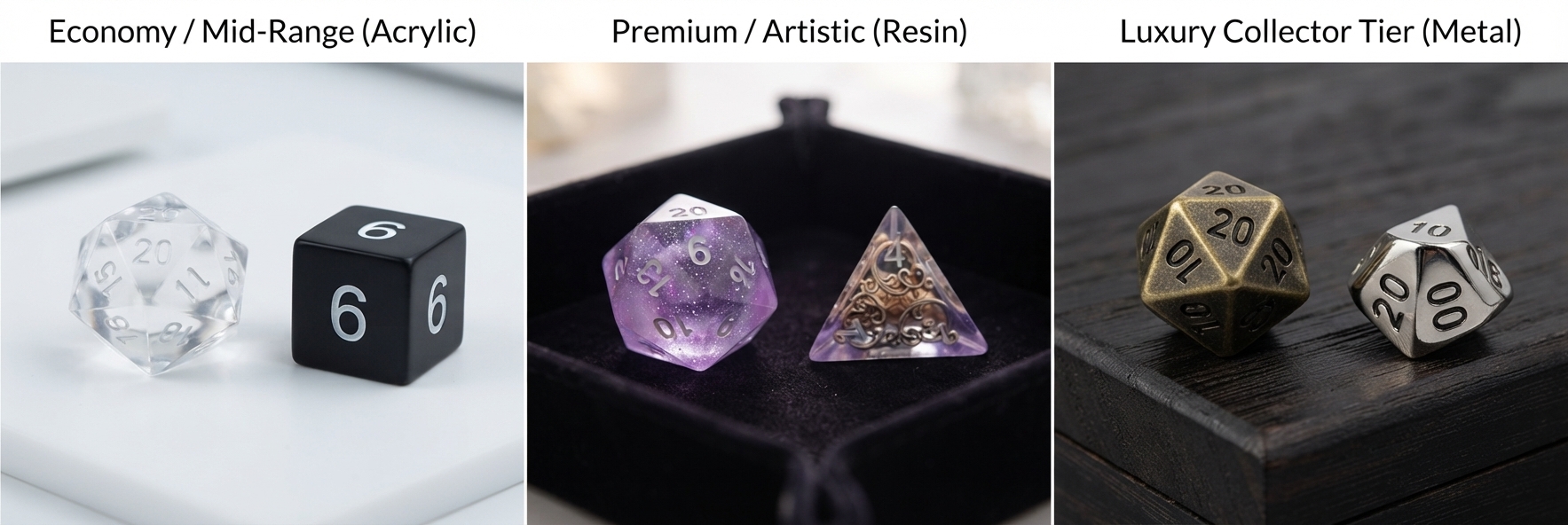
| Component / Material | Average Durability | Market Positioning | Ideal Use Case |
| Acrylic / ABS Plastic | High (Impact Resistant) | Economy to Mid-Range | Mass-market board games, high-volume production |
| Epoxy Resin | Moderate to High | Premium / Artistic | Kickstarter exclusives, transparent effects, liquid-core dice |
| Zinc Alloy (Metal) | Ultra-High (Heavyweight) | Luxury Collector tier | RPG campaigns, DND premium accessories |
03 | Navigating the OEM/ODM production cycle requires a clear understanding of factory workflows to prevent delays:
Before approving mass production, always require physical sample testing on:
- Design & Spec Submission: Clients provide vector files, 3D STL models, or conceptual sketches outlining dimensions and face layouts.
- Mold Tooling & Prototyping: Creation of steel or silicone molds for precise numbering and custom engraving.
- Molding & Casting: Material injection (plastic) or casting (resin/metal) under strictly regulated temperature controls.
- Surface Finishing & Inking: Tumble polishing, precision painting, silk-screening, or laser etching.
- Rigorous Quality Control: Weight distribution and balance testing to ensure fair rolls.
04 | B2B Sourcing Best Practices: Tabletop Accessories
When evaluating overseas manufacturing partners for your independent brand, consider the following key parameters:
- Material & Density Control: Ensure suppliers use high-grade virgin plastics or stable resin formulas, and check their weight distribution processes to avoid poorly balanced pieces that ruin tabletop gaming fairness.
- otal Landed Cost Calculation: Instead of focusing solely on the initial unit price, request exact product dimensions and packed carton weights to accurately calculate shipping, warehousing, and customs fees.
- Sample Testing & Consistency: Always request physical samples to evaluate edge sharpness, number readability, and hand-feel, while confirming that the supplier can consistently replicate the same mold precision and color mixes for future reorders.
05 | Custom Polyhedral Dice in Action
- Project Profile: A US-based tabletop publisher launched a fantasy role-playing expansion requiring 5,000 custom sharp-edge resin DND dice sets.
- Execution: The manufacturer utilized custom silicone molds with embedded metallic foil flakes and custom high-contrast numbering.
- Result: 100% adherence to weight-balance thresholds, zero transit damage due to custom foam-tray packaging, and fulfillment delivered 5 days ahead of schedule.
We often see buyers focus too much on the unit price at the beginning. Cheaper dice may use inferior plastics or unstable pigments, and the real cost can be much higher once shipping, sorting out poorly balanced pieces, and handling customer complaints are taken into account. Material density and sizing consistency are other common problems. Instead of simply asking how many sets fit in a batch, it is better to provide the exact dimensional requirements and check the packed carton weight before calculating the total landed cost.
We also recommend testing a physical sample before placing a bulk order of thousands of units. Roll the dice to see how the weight distribution, edge sharpness, and face readability perform. If you plan to reorder, don't just check whether the first batch is good-confirm that the supplier can maintain the exact same mold precision, color consistency, material mix, and logo clarity for future production runs. That consistency is usually the foundation of a long-term, reliable B2B manufacturing partnership.
06 | Frequently Asked Questions (FAQs)
F: What is the typical Minimum Order Quantity (MOQ) for custom tabletop dice?
A: For standard, non-customized dice, the MOQ typically ranges from 500 to 1,000 sets. If you require full customization (such as custom molds, unique logo engravings, or special finishes), the exact MOQ and production feasibility will depend on your specific design requirements and need to be discussed and confirmed through project evaluation.
F: How do you ensure custom dice are balanced and fair for tabletop gaming?
A: Professional manufacturers implement strict quality control measures to guarantee fair play. This includes utilizing high-precision CNC-engraved molds, maintaining uniform material density during injection or casting, and performing routine weight distribution and drop tests to eliminate internal air bubbles or weighted biases.
F: Can we customize the font, colors, and logo icons on the dice faces?
A: Yes, full OEM/ODM customization is available. You can specify custom Pantone (PMS) color matching, transparent or swirl resin inclusions, custom metallic foil flakes, unique face fonts, and custom logo engravings on specific faces (such as replacing the highest number with your brand icon).
F: Can I get a physical sample before placing a large production order?
A: Yes. We strongly recommend evaluating a physical sample to check color accuracy, weight distribution, edge finish, and number readability. Pre-production samples can be custom-made based on your design files, with sample lead times typically ranging from 15to 25 days before mass production begins.
F: What is the best way to test a supplier before placing a large bulk order?
A: Always request physical samples before committing to a major production run. Roll the sample dice to evaluate their weight distribution, edge sharpness or smoothness, number readability, and overall finish. This initial testing phase helps catch potential design or quality flaws early.
07 | Key Takeaways
When evaluating dice and tabletop component suppliers, avoid focusing solely on the initial unit price. It is essential to assess material grade, CNC mold precision, and balance-testing capabilities to ensure durability and fair play, while factoring in precise carton dimensions to manage total landed costs.
Before scaling to bulk production, always test physical samples to evaluate weight distribution, number readability, and overall hand-feel. Partnering with a manufacturer that reliably maintains mold precision and color consistency across future reorders is the true foundation of long-term B2B success.